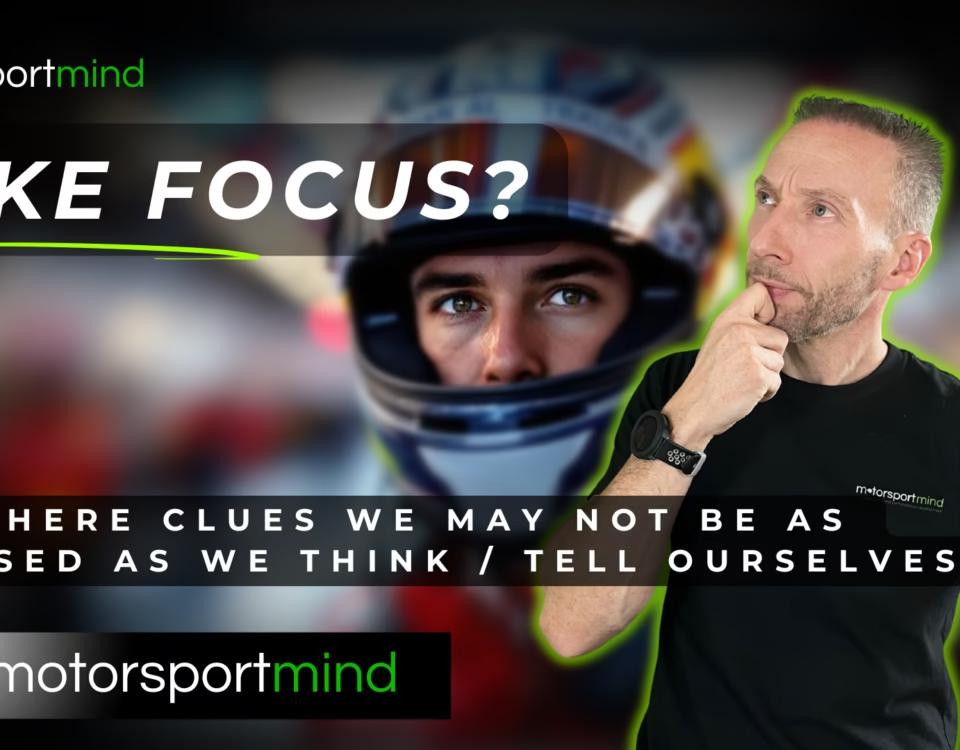
The Smartest Person in the Room? &
How to Achieve Behavioral Flexibility
Hi, everyone! This week, I want to dive into the concept of being the smartest person in the room. But what does that really mean? Well, it's all about awareness and the ability to adapt to your environment—something I like to call behavioral flexibility.
You might have heard me use this term before. Essentially, it means that the person with the most options and the most adaptable behavior will eventually be the most successful. Let's delve into why this is so crucial and how you can cultivate this skill.
What is Behavioral Flexibility?
Behavioral flexibility refers to the ability to change your behavior to suit different circumstances. This flexibility allows you to seize opportunities as they arise, rather than sticking to a fixed set of behaviors.
"The person with the most options, the person whose behavior is most adaptable, will be the most successful."
Imagine a professional driver. Unlike amateurs who might struggle to adapt to different vehicles, a pro driver can get into any car and quickly get up to speed. They don't wait for perfect conditions but instead maximize performance out of whatever they are given.
Don't Be a Goldilocks Driver
Many of us fall into the trap of becoming what I call a Goldilocks driver—someone who needs everything to be "just right" to perform well. In life, conditions are rarely perfect, and the ability to adapt to less-than-ideal circumstances is invaluable. By being the smartest person in the room, you can maintain this behavioral flexibility and make the best out of any situation.
Key Elements of Being the Smartest Person
Here are some critical elements that contribute to being the smartest person in the room:
-
Filters
-
Difference Between What’s Said and What’s Heard
-
Difference Between Looking and Seeing
Let’s break each one down.
Filters: How They Affect Us
Filters play a significant role in how we process information. When we do anything, our brains are constantly filtering information, often unconsciously. We make generalizations, deletions, and distortions based on our biases and experiences.
-
Deletions – Omitting details we consider unimportant.
-
Generalizations – Treating similar things in the same way to speed up learning.
-
Distortions – Skewing information based on our biases.
These filters affect how we interpret the world and communicate with others.
"In many ways, it’s a miracle we can communicate at all."
Looking vs. Seeing
Another important concept is the difference between looking and seeing. You might look at something but not truly see it because your filters come into play. A great experiment illustrates this: a person asking for directions was swapped with another actor while a door passed between them, and only a third of the people noticed they were speaking to someone else!
What's Said vs. What's Heard
Similarly, there's often a gap between what's said and what's heard. Filters affect not just how we process visual information but also verbal communication. For instance, someone might frame feedback in a language that's more technical, while you might comprehend things better in a more emotional, tactile context.
"The meaning of communication is the response I get."
If you're not getting the response you want, it's worth questioning how you might change your approach.
Importance of Effective Communication
Effective communication is pivotal—whether in a team setting, a garage, or a family. When giving or receiving feedback, we must remember:
-
Feedback is meant to facilitate improvement, not serve as criticism.
-
Everyone shares a common goal of success.
-
Miscommunication often arises from differing filters.
Real-life Impact
Failing to acknowledge these concepts can lead to misunderstandings, which can create friction within teams. A recent example involved a team where communication broke down because no one took the time to understand each other's filters. Eventually, this led to a parting of ways.
Practical Tips for Enhancing Behavioral Flexibility
-
Be Aware of Filters: Recognize your own filtering process.
-
Clarify Communication: Ask for clarification to ensure you correctly understand what's being communicated.
-
Adapt Your Approach: If you're not getting the desired response, change your method of communication.
-
Steps to Improve Communication
-
Be mindful of your filters.
-
Clarify what's being communicated.
-
Adapt your communication style.
-
Seek feedback to understand others better.
Final Thoughts
By focusing on being behaviorally flexible and understanding the nuances of communication, you can become the smartest person in any room. This skill set not only helps you succeed but also promotes a more harmonious and efficient environment for everyone around you.
Conclusion
Being the smartest person in the room isn't about having all the answers but about understanding and adapting to the filters through which information is processed—by you and others. This awareness allows for more effective communication and, ultimately, greater success.
If you have any thoughts, comments, or questions, feel free to drop them below. See you next time!
Take care,
Greg