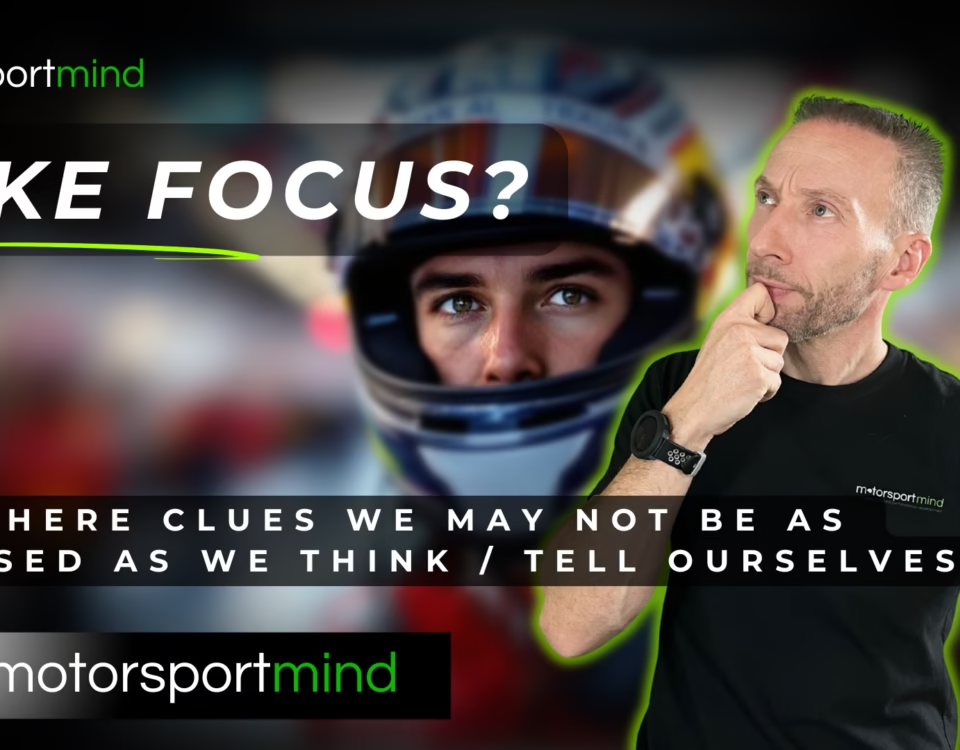
How to Ensure the Right You Shows Up in Racing

In the high-stakes world of racing, whether you are behind the wheel of a car or gripping the handlebars of a bike, your mental state is your most valuable asset. If you have been following performance coaching for any length of time, you have likely heard a lot about "noise." We talk about silencing the inner critic, reducing anxiety, and clearing the mental clutter that prevents us from performing at our peak. But what if focusing solely on the noise is actually holding you back from your full potential?
In this guide, we are going to explore why it is time to look beyond just "getting out of your own way." While managing mental noise is a massive part of the battle—roughly 60% of it—there is a critical 40% that many athletes neglect: the additive process of generative change. It is not just about what you stop doing; it is about what you start doing to ensure the best version of you shows up on the starting line.
Subtractive vs. Additive: The Performance Split
A few years ago, a driver asked a poignant question: Is mental coaching a subtractive or an additive process? In other words, is it about removing the "bad" stuff, or adding the "good" stuff? The reality is that it is both, but they serve very different functions in your performance toolkit.
To understand how to maximize your track time, you have to look at the 60/40 split:
-
The Subtractive Process (60%): This is about stopping the noise. It is the work you do to get out of your own way. When your mental noise is high, your accessible skill level is naturally low. By reducing that noise, you allow your natural ability to surface.
-
The Additive Process (40%): This is generative change. It is about taking your existing skills and helping you perform them better. This is the state-setting, the visualization, and the intentional mental prep that turns a "good" driver into a "great" one.
If you only focus on the subtractive side, you might be calm, but you aren't necessarily optimized. If you only focus on the additive side without clearing the noise, you are trying to build a skyscraper on a shaky foundation. You need both to win.
The 60%: Getting Out of Your Own Way
The first step in any performance cycle is controlling the "organism"—that is, your body and your immediate nervous system. This is where we focus on creating calmness. Why? Because calmness is the direct enemy of mental noise. When you are calm, your noise levels drop, and your focus sharpens.
Many athletes struggle not because they lack ability, but because they lack the ability to deliver that ability. Noise creates a barrier between what you know how to do and what you actually execute on the track. By mastering the first two steps of the performance process—taking control of your physical state and silencing the chatter—you clear the deck for the real work to begin.
The 40%: The Power of Generative Change
Once you are out of your own way, you have a blank canvas. This is the 40% where generative change happens. This is the part of the process that gives you a real competitive advantage. Instead of just "not being stressed," you are actively "being elite."
State Setting and Visualization
Additive processes involve state setting. This means intentionally choosing the emotional and mental state you want to be in when you hit the track. This is where visualization comes into play. You aren't just seeing the turns; you are feeling the flow, the speed, and the confidence of a perfect lap.
Maximizing Performance
The generative phase includes techniques like the "swish" or "spinning feelings"—taking positive sensations and amplifying them. It is about being "fast out of the box." While others are spending their first few laps just trying to get comfortable, the driver who has utilized the additive process is already at 100% because they have mentally rehearsed that peak state before the engine even started.
The Best Version of You: Understanding Ego States
We all have different versions of ourselves. You have a version of yourself for your family, a version for your friends, and a version for your professional life. In racing, we need to ensure that the best version of you is the one that shows up when the visor goes down.
Think back to your best race ever. Think of that version of you who felt:
-
Fast and smooth
-
Completely focused
-
In a state of "flow" where everything felt easy
-
Untouchable by outside distractions
That version of you is an "ego state." The goal of the 40% additive process is to trigger that specific state on demand. We don't want to leave it to chance. We want to make sure that that guy or that girl is the one in the seat every single time you go out on track.
Integrating the 1-2-3-4-5 Process
To make this practical, look at the standard 1-2-3-4-5 mental performance process. It is designed to mirror the subtractive and additive split perfectly:
The Subtractive Half (Steps 1 & 2)
The first two steps are all about taking care of the noise. You are taking control of the organism, breathing, grounding yourself, and ensuring that you are calm. You are clearing the mental clutter so you can actually think.
The Transition (Step 3)
The middle step involves processing notes and information. It is the bridge between clearing your mind and filling it with the right performance cues.
The Additive Half (Steps 4 & 5)
The final two steps are where you engage in generative change. You are setting your state, visualizing your success, and stepping into that "best version" of yourself. This is where you prepare to perform at your very best, rather than just "performing without noise."
Key Takeaways for Your Next Race
To ensure you are utilizing both the subtractive and additive processes, keep these insights in mind for your next race weekend:
-
Don't ignore the noise, but don't obsess over it. Use your tools to bring the noise down, but don't stop there.
-
Check in with your state. Ask yourself: "Is the right version of me showing up right now?" If not, use visualization to pivot.
-
Be fast out of the box. Use the additive 40% to mentally "pre-load" your performance so you don't waste valuable track time getting up to speed.
-
Give equal attention to all steps. You cannot take for granted that a lack of noise automatically means a peak performance. You must actively build that peak state.
-
Spin the good feelings. When you feel a moment of flow or confidence, don't just let it pass. Anchor it, amplify it, and make it part of your additive toolkit.
Conclusion
While it is tempting to focus entirely on "stopping the noise," true elite performance requires a more holistic approach. By recognizing the 60/40 split between subtractive and additive processes, you can stop simply "getting out of your own way" and start actively driving toward your potential.
Remember: 60% of the work is creating the calm, but the other 40% is where the magic happens. It is the generative change that allows you to be the fastest, smoothest, and most focused version of yourself. Don't just forget the noise—remember the additive process that makes you a champion. Next time you head out on track, make sure you've done the work to bring the best version of you to the grid.